

From husk to shipment.
Follow preparation, conditioning, testing and packing. Treatment and dispatch details are agreed for each order.

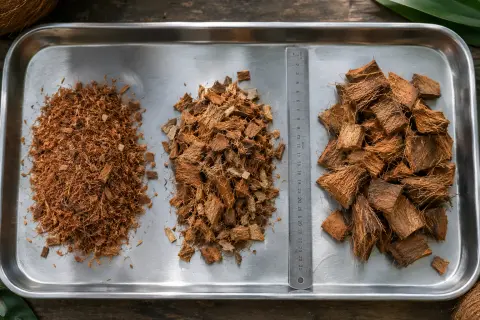
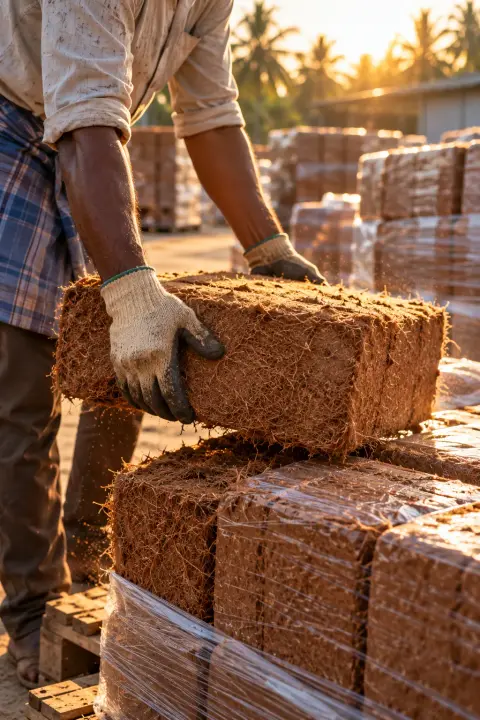
Physical progression · raw husk to wrapped export block · illustrative scene
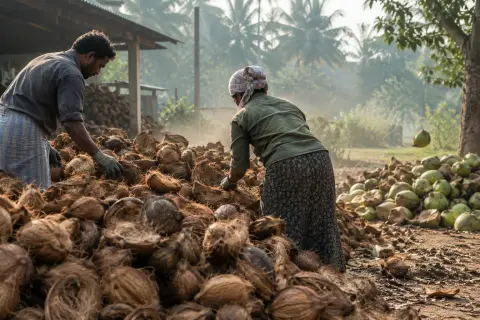
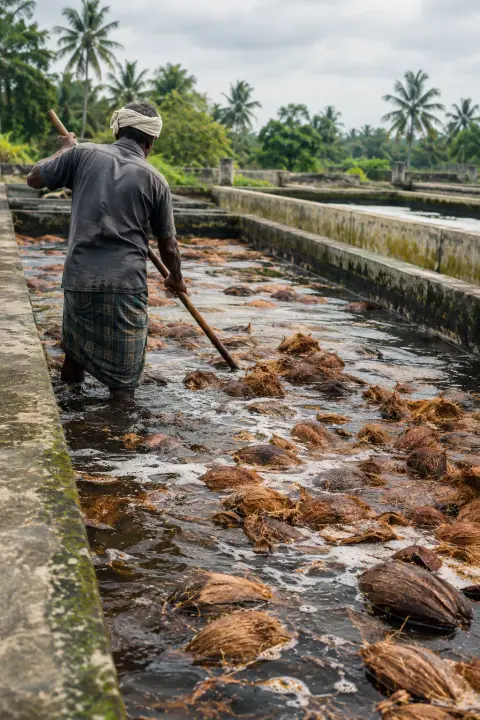
Raw preparation
Husk to separated pith.
Husk selection determines everything downstream — maturity, soak and separation are controlled before any material is called cocopeat.
- 01
Husk collection and grading
Coconut husks are collected and graded from designated local coconut farms and processing yards; sourcing controls qualify husks against agreed operations, while green and immature husks are rejected at the yard gate to maintain consistent cellulose structure.
Output: Graded brown husks - 02
Retting & soaking
Husks are steeped in freshwater soaking basins to soften the fibrous mesocarp and loosen pith from coir fibre; soak duration is monitored seasonally without unmeasured holding.
Output: Softened, soaked husks - 03
Defibering & extraction
Mechanical decortication separates long bristle and mattress fibre from the spongy coir pith; raw fibre is diverted to separate baling lines.
Input mesocarp Soaked coconut huskMechanical decorticator Spiked drum separationExtracted coir fibre Bristle & mattress fibre → Baling lineRaw coir pith Spongy mesocarp particles → Curing heapsOutput: Raw coir pith + extracted coir fibre - 04
Pith ageing & curing
Fresh pith is accumulated in open-air curing heaps to mature naturally, allowing tannin stabilisation and initial aeration; material cures to process boundary before entering the washing line.
Output: Aged, stabilised raw pith
Wash & condition
Removing what roots dislike.
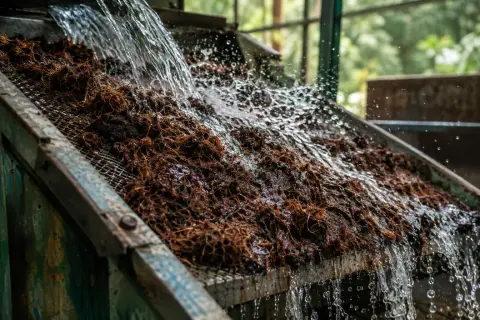
Washing, optional buffering and drying set the chemical profile. Buffering runs when the order specifies low-EC material.
- 05
Freshwater washing
Multi-cycle rinsing flushes water-soluble potassium, sodium and chloride salts; cycle volume is set by incoming raw EC to bring conductivity within agreed contract bounds.
- 06
Buffering
When specifiedCalcium nitrate treatment displaces bound sodium and potassium from the cation exchange complex; performed only on orders specifying buffered material, omitted for unbuffered grades.
- 07
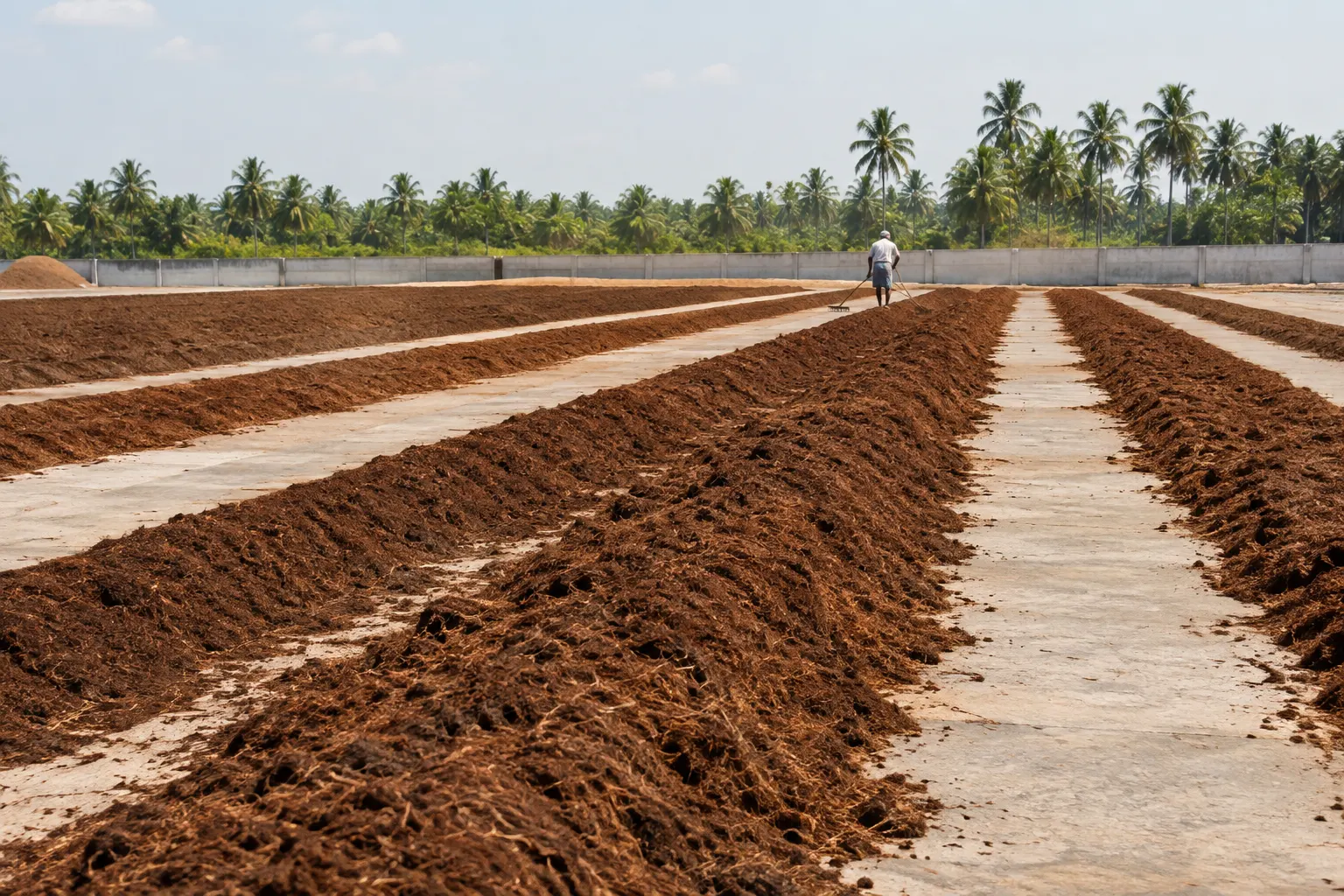
Drying
Solar drying on concrete yards, with mechanical rotary drying deployed during monsoon; moisture is brought steadily toward the agreed packing specification.
Finish & test
Screened, measured, approved.
The material is sieved to fraction and tested before compression — this is where the specification is actually checked.
Screening & fraction
Rotary screens and vibrating sieves remove fibre remnants, oversized particles, sand and dust; mesh size is configured to the agreed particle fraction. Non-conforming fractions are re-screened or diverted to secondary applications.
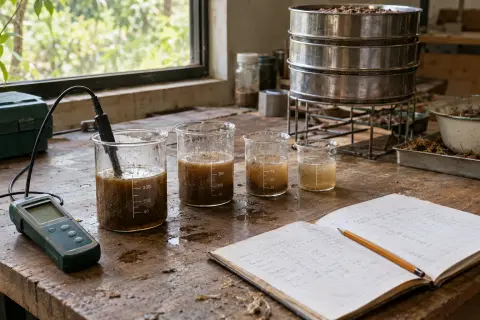
Sample & test before compression
Representative batch samples are tested in the yard laboratory for EC, pH, moisture and expansion ratio. Failed batches return to washing or drying; no unapproved batch proceeds to press.
Pack & dispatch
From approved pith to loaded container.
The approved material becomes shipment: compression, wrapping, palletizing, treatment and supervised loading.
- 10
Compression
High-pressure hydraulic presses compact approved pith into dense blocks (typically 5 kg format) or specified briquette/disc formats; press dies are set per order.
Output: Compressed export units - 11
Wrapping & labelling
Units are shrink-wrapped in LDPE film or poly-strapped with agreed buyer labelling; buyer label and wrapping format are confirmed before production begins.
Output: Wrapped, labeled units -
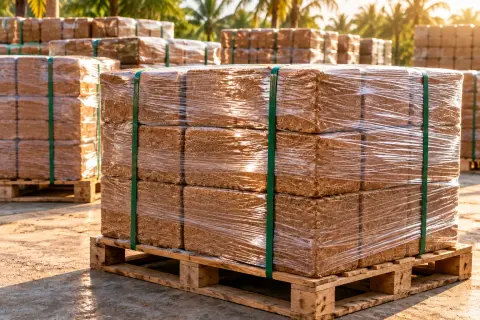
Unit wrapping · illustrative packing scene - 12
Palletising & strapping
Blocks are stacked in interlocking patterns on four-way export pallets, edge-protected, shrink-shrouded and strapped; floor-loaded container orders bypass pallet configuration.
Output: Shipment-ready pallets - 13
Treatment & documentation
When requiredWooden pallets receive ISPM-15 heat treatment or fumigation where required; phytosanitary inspection and export certificates are completed per destination country standards.
Output: Treatment + document set - 14
Loading & dispatch
Supervised container stuffing into 20 ft or 40 ft HC containers, load securing, seal verification, and transport to Tuticorin or Chennai port; port and loading details are verified per order.
Output: Sealed, dispatched container
Next steps
Handover to evidence and export.
Manufacturing integrity is backed by calibrated testing protocols and clear export documentation.