
Victory Enterprise
Menu

Laboratory standards & parameters

A specification needs a method.

Target values and actual batch results serve different purposes. A target is agreed before manufacturing; a result is measured from the sampled lot. Neither figure is complete without the specific test method used to measure it.

Target agreed before the order
Result recorded for the tested sample
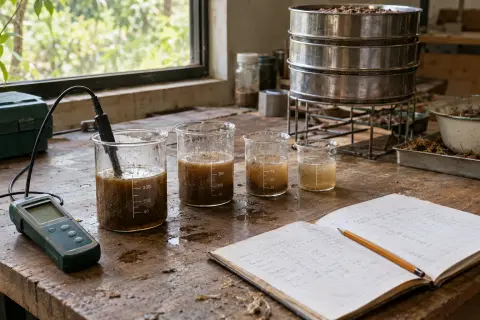
Testing bench with calibrated meter, beakers and sample jars
Testing bench · calibrated meters and extraction slurries

Specification ledger

What the record needs to show.

Every tested parameter balances an agreed target with an explicit extraction method and operational context. Current targets are confirmed in your quotation.

#ec

Electrical conductivity

Confirmed with your quotation Quotation bound
Meaning & context

Measures dissolved mineral salts (primarily sodium and potassium); low-EC buffering displaces these ions where salt-sensitive crops need it — outcome always depends on your crop, water and management.

Testing method

1:1.5 volume extraction with demineralized water; calibrated digital meter

Extraction standard: 1:1.5 volume extraction

Demineralised water basis; readings vary under 1:2 or 1:5 dilution.

#ph

pH

Confirmed with your quotation Natural band
Meaning & context

Cocopeat naturally sits in this slightly acidic band, which supports availability of N, P, K and micronutrients — final root-zone pH still depends on your water and nutrition plan.

Testing method

Direct reading from the settled 1:1.5 slurry, calibrated probe

#moisture

Moisture

Confirmed with your quotation Packing target
Meaning & context

Freight economy (pay for substrate, not water); a moisture target at packing — not a biological or transit guarantee.

Testing method

Gravimetric oven drying at 105 °C to constant weight

#expansion

Expansion volume

Confirmed with your quotation Per 5 kg block
Meaning & context

Predicts final usable substrate volume for commercial potting runs; final yield depends on your water quality and soaking method.

Testing method

Controlled rehydration under standard ambient conditions with measured water

#impurities

Impurities

Confirmed with your quotation Sieve limit
Meaning & context

Confirms bulk volume is active spongy pith, not sand or inert filler.

Testing method

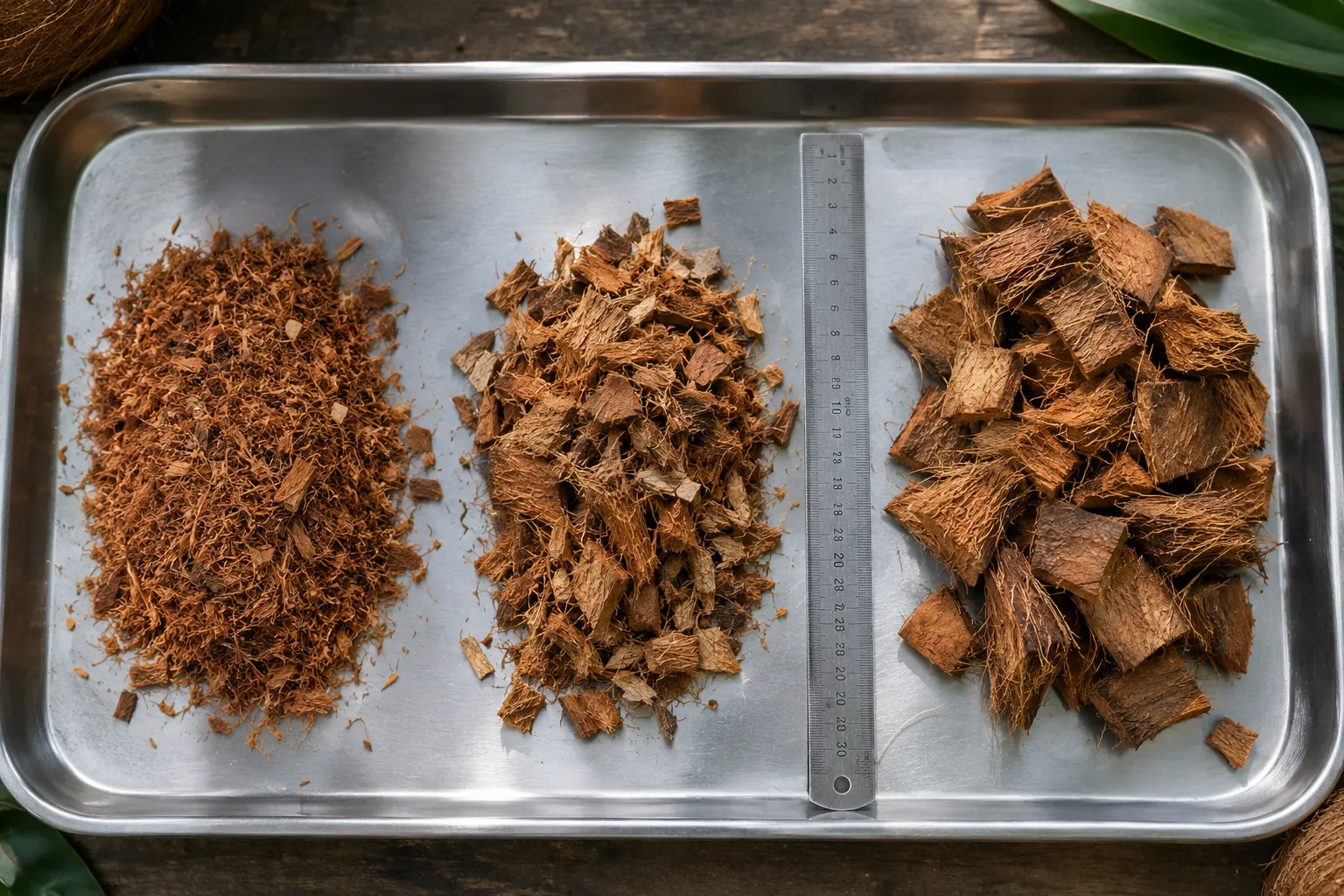
Mechanical sieve separation; gravimetric analysis of <1 mm dust/sand and un-retted fibre

Coir pith sieving and grading sample tray with three separated fractions
Grading sample tray · mechanical sieve separation of pith, chips and short fibre

Testing sequence

Sample, test, report.

Every production lot follows a three-step verification sequence before compaction and container stuffing.

  1. 01

    Agree target & method

    Agreed purchase specification confirmed with customer order; extraction ratio (1:1.5 volume extraction), target electrical conductivity, pH tolerance, and packing moisture defined before processing begins.

    Output: Confirmed purchase specification & protocol
  2. 02

    Sample & test before compression

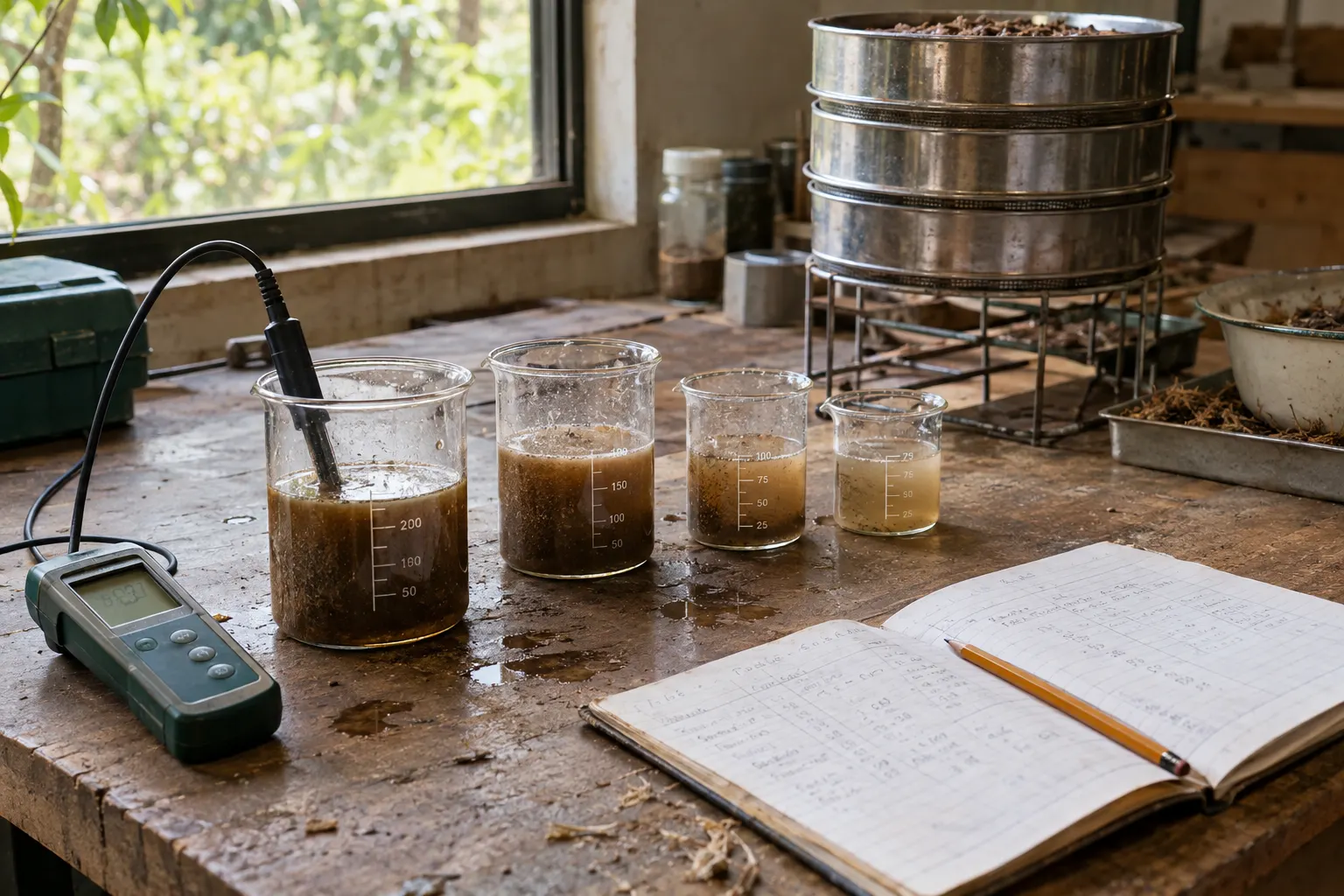
    Representative composite samples gathered during screening before hydraulic compaction; tested in yard laboratory for EC, pH, moisture and expansion yield.

    Laboratory testing bench showing sample jars, digital EC meter and graduated cylinder
    Pre-compression yard laboratory testing bench
    Output: Verified sample readings & disposition record
  3. 03

    Review & document disposition

    Readings cross-checked against agreed purchase tolerance. Failed batches return to washing or drying; no unapproved batch proceeds to press.

    Output: Batch Certificate of Analysis (COA) release

Methodology comparison

Compare readings on the same basis.

Extraction ratios and raw water conditions directly change the reported values. Comparing figures without their measurement method compares different physical phenomena.

Extraction ratios are distinct laboratory procedures.

Extraction ratios are different physical preparation procedures, not mathematical conversion factors. Measuring the same coir sample with 1:1.5 vs 1:5 volume extraction yields completely different conductivity figures because water volume alters ion dissociation and dilution.

We report EC under the 1:1.5 volume extraction standard with demineralised water. When comparing quotations across suppliers, verify the extraction procedure before comparing the numeric values.

Standard substrate laboratory extraction methods and reading basis
Ratio Reading basis & reporting relevance
1:1.5 Our quoted method — always stated with the value
1:2 Different ratio, different number from the same material
1:5 Diluted extract — not comparable with 1:1.5 figures
Different procedure: PourThru

PourThru is an in-situ greenhouse leachate extraction technique conducted on established root zones in pots or slabs. It is a crop monitoring procedure, not an uncompressed raw material laboratory batch test, and cannot be mathematically converted to 1:1.5 slurry figures.

01 Method mismatch

EC figures quoted without their extraction ratio (1:1.5 vs 1:2 vs 1:5 vs PourThru) cannot be compared between suppliers or lots. The identical substrate will measure lower under 1:2 and substantially lower under 1:5 dilution.

02 Water & preparation

Rehydration water quality directly influences the root-zone reading. Expanding substrate with well, municipal, or reverse-osmosis water introduces the background conductivity of that water into the finished root zone.

03 Crop & system context

Optimal conductivity depends on crop species, growth phase, fertigation strategy, and greenhouse drainage management. No universal single EC number is ideal for every grower or every horticultural environment.

Batch verification

Ask for the record behind the order.

Batch documentation is requested through Quality — contents are confirmed with your order. When placing an inquiry or confirming a purchase contract, ask our trade desk for the representative batch records and certificate of analysis format for your specified grade.

Certificate of Analysis Structure outline
  • Batch/reference [Assigned per production lot]
  • Sample date [Pre-compression test timestamp]
  • Method [1:1.5 volume extraction / gravimetric]
  • Parameter [EC, pH, moisture, expansion, impurities]
  • Result [Tested reading logged against order spec]
  • Review [Quality controller sign-off & release]

Example structure — not a batch result